Event

From winter to summer: Spring breakers serve and learn in Three Rivers

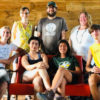
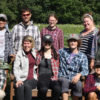
In one respect, the two service-learning trips we hosted in March couldn’t have been more different, by which I mean the weather. We welcomed five students and a staff mentor from Geneva College in the first full week of March and, wowee-zowee, winter’s grip was holding tight on southwest Michigan, with snow and freezing temps keeping us cloistered indoors for most of the week. Fortunately, one of the nicer days encompassed the afternoon of our farm tours. On the other hand, the Calvin College trip last week was eerily summer-like, as we enjoyed temperatures in the 70s and 80s, with just a day or two of rain — another very nice day for farm tours, although it was an unsettling niceness and the farmers were nervous about the future effects of the temperature fluctuation.
Let me take a step back before I tell you more about these two trips in particular. *cino has been hosting spring break service learning trips since we partnered with Calvin College in 2010. (You can see our reports from 2010 and 2011 in our archives.) Over the three successive years, we’ve been developing the trips along the themes of rule of life and place. By rule of life, we mean the way we organize our time around what’s important to us. Toward the end of exploring this theme, we spend time with local intentional communities and practice our own basic daily rule together: morning prayers, work period, lunch, community explorations, an hour of silence, and cooking and eating a meal together. As we practice this rule, we also delve into the theme of place. In a cultural climate that values multi-tasking, movement and efficiency, we experience what it might look like to focus instead on rootedness, rest and listening. In the midst of divided attention and impulsive purchasing, we practice stillness and intentionality.
The “canvas” for much of our exploration was in the form of field trips throughout the community. Here are the themes that we addressed in our afternoons:

  • Agriculture: We visited five local farms between the two trips, including Bluebird Farm, White Yarrow Farm, Sustainable Greens, Bair Lane Farm and Corey Lake Orchards.
  • Journalism: Elena Hines, editor of the Three Rivers Commercial News, and Bruce Snook, founding editor of River Country Journal, discussed the importance of recording our community’s stories.
  • Aging: Tracy Kiel and her colleague Kristin hosted us at Riverview Manor, a skilled nursing facility, and engaged in conversation with Janell Hart and Renee Welch from the county’s Commission on Aging about issues facing the older members of our community.
  • Youth: We brought together Stephanie Morgan (young adult librarian), Stephanie Schoon (director of Three Rivers Area Mentoring) and Chief of Police Tom Bringman, who were able to talk about their work with youth and some of the needs of the community related to children and young adults.
  • Arts: We toured the lovely Carnegie Center for the Arts, along with local public art and outlets for local artists, including the Pink Paisley Poppy Emporium and UniQ Jewelry. The Calvin group met with local artist couple Larry-Michael and Becky Hackenberg at their home on the St. Joseph River, while the Geneva group heard from local artists Emily Ulmer, Gail Walters and Michael Northrop. The Calvin group also had the opportunity to enjoy a house show by David Bazan.
  • Local Business: In addition to informal time wandering around the historic downtown district, we visited with the owners/managers of World Fare, Love Your Mother, the Riviera Theatre and Lowry’s Books.
  • Intentional Communities: Both groups stayed at least a portion of their time with the *culture is not optional intentional community at Trinity Episcopal Church and visited St. Gregory’s Abbey to talk with Brother Abraham and participated in vespers and meditation. Both groups also practiced an hour of silence every afternoon. The Calvin group stayed a portion of the week at the Hermitage Community, where we participated in morning prayers.

Each group of students had its own unique character, and we enjoyed the times of laughter and teasing, as well as the times of serious reflection and conversation. Our hope is that the experience of the week nourished the soil of each heart in some way for the future. One question we discussed around the table at our closing potluck for the Calvin trip was, “If you had to plan a trip like this in the place where you grew up, what would you do, who would you meet with, where would you go?” I think if our student friends can begin to answer this question and see the places where they are with new eyes–the eyes of love, of intentionality–then our work has been productive. I think another marker of success is if each of us can find a little bit more space in our lives to surrender, whether that surrender is in the form of rest or silence or worship or giving up our self-centeredness for the sake of community. To steal a quote that our friend Jeff stole from Wendell Berry for his blog recently, from a poem called “Healing”:

The teachings of unsuspected teachers belong to the task, and are its hope.

The love and the work of friends and lovers belong to the task, and are its health.

Rest and rejoicing belong to the task, and are its grace.

Let tomorrow come tomorrow. Not by your will is the house carried through the night.

Order is the only possibility of rest.

We ended each trip with a potluck dinner and several of the folks who met with our groups throughout the week joined us. I couldn’t help but smile at the sight of people who didn’t know each other just days earlier enjoying one another’s company. For all of the ambitious learning outcomes we might seek to achieve with such trips, perhaps the simple ability to combine chatting and eating should be at the top of the list. It’s around the table, after all, that we are made fully known in the breaking of bread and the drinking of wine.
For more photos, see our Geneva and Calvin Spring Break photo sets on Flickr.

Read More →

Organization, People, Three Rivers

Beginning the conversation

Welcome to the *cino Talks blog! I’m Stephanie, one of several residents of the *cino community who live and work in Three Rivers, Michigan.

It feels quite remarkable to remember that just over a year ago, a group of college friends relocated from Grand Rapids to this rural small town in southwest Michigan and into the generously shared space of Trinity Episcopal Church’s rectory. Although many friends from this initial gathering have since embarked upon other endeavors, ongoing conversations have encouraged other college students and postgraduates to spend some time here in Three Rivers as well. I often recall the particular conversation that kindled this decision to join friends here in Three Rivers; a memory that includes the question, “What if a group of friends decided to move to Three Rivers this summer?”

It was springtime, and a pleasant enough day to perch piles of books on a courtyard table to peruse the themes of hospitality, imaginative living, and a faithful commitment to place. Yes, it was none other than Rob and Kirstin, leafing through pages and planning their first spring break trip — a foray into “art, agriculture, and development in rural communities.” Now, when you bump into such delightful friends and catch sight of the well-worn texts written by Cornel West, Wendell Berry, Brian Walsh, Kathleen Norris and the like, all collected together into an epitome of all that your college courses could explore, you get a little curious. And maybe a bit excited.

Rob and Kirstin went on to describe the spring break trip as both ethnographic and participatory, where students would traverse the rural small-town landscape of Three Rivers and visit local organic farms, learn from community members including artists, activists, historians, writers, and business owners, prepare shared meals with locally-sourced food, do service work at *cino’s Huss School building, and live and learn at the Hermitage, a serene Mennonite retreat center located in the hills west of town. This trip would encourage students to envision a community that is informed by a Christian “rule of life,” but also one that is learning-based, service-oriented, imaginative, and committed to the local culture and identity of Three Rivers and the other places we call home. As a student who was preparing to finish college with various opportunities pulling me in several directions, I was quite intrigued by this alternative vision for community. It was this very conversation, and many to come, that seemed to incite a small and ongoing migration of friends to Three Rivers.

Now why am I focusing so fixedly on such a memory? This memory reflection has recently served to unearth a period of questioning, the most pressing of which is the question of why I still believe in the work and identity of *culture is not optional. When I consider all that this past year has encompassed, I can undoubtedly say that it has indeed been a period of practicing hospitality, of striving to commit to this place, and of allowing our imaginations to shape the work that we do together. Sure, I cannot altogether affirm that our presence here has been characterized by an unceasing creative momentum and a clearly defined vision, nor did I ever expect for it to be so. But those initial conversations about how we are to live whole lives in this community still persist, allowing space to ask questions and work through the wobbles and gaps in my own understanding of *cino’s presence in Three Rivers and beyond.

As Kirstin introduced in the opening blog post for the *cino Talks, *culture is not optional, as an organization and gathering of friends, is transitioning into a period when we give greater attention to the mission and vision of this organization. If you’re reading this blog, you’ve most likely participated in some small or large part in *culture is not optional, whether it be living and working in Three Rivers, reading and writing for <a href=”http://www.catapultmagazine.com”><em>catapult magazine</em></a>, visiting <a href=”https://www.cultureisnotoptional.com/space”>Huss School</a>, or all the many other ways you’ve chosen to support this community. The *cino Talks is a dialogue where we hope to include your thoughts and observations regarding *culture is not optional’s organizational identity.

So, in a roundabout way, we’re asking if you can join us in reflecting on two questions for this initial phase:

  • Why is *culture is not optional important to you?
  • What limits your support of *culture is not optional?

These questions are broad, but your thoughtful and honest reflection is very valuable for *cino as we seek to move forward into a clearer identity and vision in the upcoming months. Answers can be <a href=”http://www.catapultmagazine.com/contact”>submitted here </a> or via the comment section below.

So, again welcome to the *cino Talks blog. We hope that it can become a space where you can also reflect on the ways that *culture is not optional has become important to you and participate in the ongoing conversations about faith, community, culture, place and so much more.

Read More →

Building, Fundraising, Online, Organization

Report from the Culture Make Sale

An enormous “Thank you!” to all who participated in the Culture Make Sale, whether by contributing goods and offering services, purchasing others’ donations, or simply perusing the website and sharing in the event.
*culture is not optional’s network stretches across the globe, and thanks to the success of the Culture Make Sale, that web of connections is growing! Over the past two months, friends of *cino new and old, from all over, have given and received gifts of time, energy, and resources, to benefit the renovation and development of the former Huss School building into a community center in Three Rivers, Michigan. Handmade ceramics, customized love letters and website design, brilliant books and poetry, yard work, artwork, apple pies, and so much more – these are little bits of human culture that enrich our lives, and all the more so when they are shared.
Thanks to all for helping raise over $1500 for the Imagining Space at Huss School! Your continued support ensures that Huss School is on its way to becoming a place of peace, hope, and justice.
Additionally, the sale will continue soon in Three Rivers: World Fare, a fair trade store downtown, has partnered with *cino as an outlet to sell goods that give life to projects and endeavors in the local community. Be sure to stop by 37 N. Main St. in the near future and check out the many wonderful items still on sale!

Read More →

Uncategorized

Make neat things, buy neat things … support *cino!

Imagining Space, the project that *culture is not optional (*cino) has undertaken to renovate the former Huss School building in Three Rivers, Michigan, is a venture in creativity. Our vision is to develop the site as an intergenerational community and educational center and an semester program for college students. Already in place at the property is a community garden that donates over a thousand of pounds of fresh vegetables to families in need every year. Also, two annual “Future Festivals” have drawn the community into the space for summertime fun. Imagination and creativity are central themes which drive this endeavor’s efforts toward hope, justice and grace, and the Culture Make Sale as a fundraiser is a perfect fit for the spirit being cultivated at the Huss School property.

Handcrafted items and customized services of all sorts are available for sale online through September 30, and all proceeds will benefit the continuation of the building’s revitalization. Goods such as stationery, art, photography, clothing, poetry, ceramics, and more have been donated by supporters all over the country. In addition, the sale features many services, such as a session with a consultant on writing a college application essay, a website design, and a customized handmade quilt, love letter, embroidered icon; the list goes on.  Browsers are encouraged to check back often, as new items are being added weekly. Some services are only available in the Three Rivers area, and free pick-up on select items is available.

*culture is not optional is still accepting handmade items and services as donations to the sale. Visit the donation page to find more information about contributing.  The page also includes a list of ideas for what to donate.

The sale’s name comes from the book Culture Making by Andy Crouch, which challenges Christians to be actively involved in culture, creating rather than simply consuming or condemning what’s going on around them. “We’re really excited about how this sale reflects our future hopes for the Huss School property,” said *cino co-director Rob Vander Giessen-Reitsma.  “We hope it will be a space of creativity, joy and collaboration, which is what the Culture Make Sale is all about.” Participate in “culture making” by purchasing homemade goods and services, or by offering to donate your own talents and gifts!

Links for more information:

Read More →

Uncategorized

Culture Make Sale coming soon!

The Culture Make Sale held a wonderful preview event at the Huss Future Festival on July 30, featuring jewelry, stationery, framed photographs, *cino mugs and more. There will be so many great items to choose from when the online store launches on September 1 to help fund the development of a community center and off-campus program! Supporters from all around the world can participate in this project by donating and purchasing a wide array of handmade goods and services. On the list of items so far: a web site, a customized love letter, a customized icon, a handmade jewelry box and college application consultation sessions. What can you contribute? Please get in touch if you have something to give…and watch the Culture Make Sale web site for more details!

Read More →

Building, Event, Fundraising, People

Report from the Future (Festival)

Huss Future Festival took place last Saturday, as 300 visitors from near and far filled the hallways with music, laughter, participation and creativity. We had a good ol’ time and raised over $600 for the Imagining Space Project at Huss, in addition to raising funds for Triple Ripple Community Gardens and the annual Back to School Celebration. See the Imagining Space blog for a full report from the festival, as well as our photos of the event. CAUTION: if you missed it, you’re going to wish you hadn’t!

Read More →

Event

Report from ^camping 2011 in Ohio

Feeding the chickens
Steve and Mel Montgomery’s wonderful hospitality began the moment we pulled in the driveway of their lovely 65-acre farm and only grew over the three days of ^camping is not optional. A beautifully restored, three-story white house stands guard at the top of the hill over acres of pastures and woods. As an educational space overseen by the Montgomery family, along with a board of directors and a group of core partners, Lamppost Farm is a place of teaching and conversation around faith as an everyday way of life — a perfect dovetail for a co-sponsored event with *culture is not optional.
Highlights of the weekend included:

  • Talking and relaxing around the campfire.
  • Learning how to slaughter and process grass-fed Lamppost Farm chickens and having good discussions about life, death, meat and normative behavior.
  • Watching Drew Montgomery’s baseball team win their Friday night game.
  • Playing corn hole with minimal scoring and maximum coach-talk cliches.
  • Reuniting with old friends and meeting some new ones.
  • Cooking and eating fantastic meals with meat and produce raised (and even butchered) right at the farm.
  • Playing with farm pets, including Misty and her new kitten.
  • Sharing the joys and struggles of running small, start-up non-profit organizations and wrestling with issues like health insurance and retirement savings in the context of a life of faith and risk-taking.

For a visual account, check out our photos of the event. We hope for the best as the Montgomery’s and their partners continue to cultivate the mission of the farm and look forward to our next visit. Our time there really whet our appetites for this summer’s second ^camping event at Maple Tree Meadows in Three Rivers — registration is open now!

Read More →

Event, Fundraising, Organization, People

Future Festival 2011 + Three Rivers camping

Join us on July 30 for the Second Annual Huss Future Festival! This year’s event will include live music, food from the Triple Ripple Community Garden and the Three Rivers Area Faith Community, an art and art supply sale sponsored by the Three Rivers Artist Guild, a used clothing sale … and more! We invite you to drop by to get a glimpse of the vision for the Imagining Space at Huss School.
On July 28-30, we’re also partnering with Maple Tree Meadows to host a ^camping is not optional event in Three Rivers. This beautiful farm is only ten minutes from Huss School, making it an ideal place to stay if you’re coming into town for the Future Festival. Our camping events are very informal, but provide plenty of opportunities for sharing good food, stories, farm chores, songs and more. If you’d like, you could also volunteer for the Festival while you’re here; just send us a note to let us know you’re interested. We have limited space available, so register early!

Read More →

Uncategorized

My First Day at (Huss) School: Education after Graduation, a.k.a. Workship

My last day of school at Calvin College was rife with mixed feelings. Of course I was relieved, excited, and well past ready to have completed such a grueling four years. The prison gates were, finally, finally, opened. And yet, the closure of such a deep experience also left me bereft, apprehensive, and lost. Out of the prison gates I had no idea where to go.
This crisis of direction is not unique to me in particular and probably not to any single generation; however, I venture that my generation experiences this crisis in a different way. A whole new age group–the “20-somethings”–has fallen into the current cultural lingo and, perhaps as well, the current existential experience of people like me. Typically, this group is characterized by the college-graduated-jobless-living-at-home-with-parents 20-something-year-old who, despite rigorous education, has no idea what to do with life. How’s that for irony you hipster grads?
This common experience has serious repercussions, one of which is a deep sense of malaise. Post-graduation there is a sense that something has been lost, that one has been left in the dark. Well-trained, the graduate now sets sail out past the reach of the lighthouse and its guiding light. We come to find ourselves in dark and troubled waters, perhaps more dark and troubling than the absurdly late night study crams our institutes disciplined into us. For now we must row alone.
The problem, however, comes amidst the tumultuous waves and stormy skies of goodbyes and transition. Dropped into our rowboat, still frantically paddling from our senior sprint, we charge aimlessly, having no idea where to go in this wide sea. At graduation I found myself in the throes of paradox: I had reached my hard fought destination, the end toward which I’d been aiming for so long, and yet I knew no home. I was restless. To continue my education, to bear its fruit. Restless to continue the friendships and community I had so rooted myself in. Restless to still belong somewhere.
I had arrived but where I had arrived was transitional. The same goes for college–a drawn out transition from a coddled teenager to an “independent.” And the same goes for everything in the foreseeable future: everything from my summer here in Three Rivers to my time at L’Abri in Switzerland to wherever I finally “settle” (for even there my experience will leave me a nudge out-of-place with my family and friends scattered across the earth).
And it was a whirlwind, be assured. There I was, in transition, all of my airport hellos and goodbyes rolled into one heart-rending blur compounded by family and friends and then almost entirely dissolved just a weekend later. Graduation is not only too abrupt it is profane. It fails to revere such a sacred time. But alas.

* * *
All of the above was what spilled out in my first reflection time after a morning’s work at Huss School. Asked to reflect on the “imaginative space” Huss is deemed to be, I found myself only struggling against the whelm of graduation, its emotions but also its import. What had struck me the most as I worked was the deep sense in which college (and twenty-two years of American (yea human) life) had oriented me in a certain direction, pushing and pulling me toward . . . something, something that inhabited an implicit space in my thoughts and heart over the years and something that remained fluid and vague even as I graduated. That something is something I think I’ll have many years to work out. But what I want to consider here is simply the experience of being oriented toward.
Rob and Kirstin told us as we met for the first Huss School work day that we would end the day with a half-hour of reflection. A time to consider our work and the imaginative possibilities it might spark. This got me going, needless to say, on thinking about the nature of work. I was raised with a fairly strong work ethic so it wasn’t necessarily griping that raised these thoughts. I was, however, tired, without breakfast, and assigned to not only move piles of wood from one end of the building from which they’d just been moved, but also to empty and restock sawdust toilets! (In fact, the sawdust toilets were surprisingly simple, clean, and much less frightening than the dark abysses of other portable waste management facilities).
As things started moving, however, I regained some spirit. It was nothing special, but I made a point of cleaning thoroughly, keeping in mind how I would respond to a toilet spotted with sawdust when already apprehensive about this “alternative” option. Now, I won’t feign any profound spiritual or emotional experience . . . I was tired and wanted to go home. But I did ponder something I had heard before. A teacher and good friend in high school once offered me a Buddhist koan that goes something like this:
A master and his student are living together and each day the student fiercely practices his meditation. Set upon achieving nirvana the student meditates with almost physical exertion, as if trying to grow a beard over night (sorry, my addition). Meanwhile the student’s master quietly goes about the daily chores. Finally, in a collapse of exhausted frustration the student asks his master “Why are you doing the chores, why do you not mediate incessantly like me?” The simple reply: you can find nirvana in doing the dishes.
Perhaps one way to understand this story is to make a distinction. As Mother Teresa has been quoted, we are called to be faithful not successful. And I think this goes for all aspects of our life, regardless even of whether we consider ourselves religious or not. The Buddhist student is misguided not because he meditates but because he tries to succeed at meditating, whereas his wise master meditates faithfully. For the student, it is as if he has some dead-lined goal he believes he can achieve by following these certain steps. For the master, on the other hand, nirvana is something much more fluid, moving in and out of his daily life, constantly re-centering him.
As I performed my menial labor I had two thoughts: one, “this sucks we’re just gonna have to do it again” and, two, “but that’s ok.” Initially, I found myself confounded by this seemingly pointless work–I had a two degrees for Pete’s sake and I was sweeping floors?! However, in asking what the point was of this work, I saw how progress-oriented I had become in my college years. Sure, the plans for this school are much greater than constantly cleaning a not-yet-renovated building and, sure, we definitely need things to get going. However, especially with *cino’s Huss School project, the point is not to succeed.
Instead, I offer the clunky term of “cyclical traction” as the point of all our work. Rather than positing some success-goal toward which we linearly progress, faithful work is something of a tornado. It is work that centers on some essential spirit–“the imaginative space,” for example–and then, in its whirlwind, hopefully it touches down, tears up a bit of ground, and makes a difference. The equally clunky visual/substitute-asterik-break would look something like this:

3170844-2-way-arrow-spirals-over-white-isolated.jpg
Work of this kind should rather be called something like “workship” for it is work that faithfully worships something. Something like finding nirvana in doing the dishes, work centered on the imaginative spirit living in *cino is a matter of remaining faithful to core principles. Hence, the all-by-hand parking-lot weeding session held last week in the name of environmental care. Even at this level of the mundane it matters how you work, the way in which you see it as a worshipping practice of a worthwhile idea and not just some pointless task to keep the interns busy.
In this way, I’ve come to see my internship much more as an apprenticeship. I am here to help and I hope to serve the project as effectively as possible; however, my time here is temporary and the gift I receive during it is this new education that doesn’t merely equip me to succeed but even more forms me to be a more faithful person. Faithful to the work I do, to the life I lead, to the community in which I’m in.
The same teacher who offered me the Buddhist koan also suggested that all middle school students should be sent to labor camps. Outrageous it may be, but his suggestion hits on this idea of workship I’ve explored, for the aim there would be to harness all that wild energy, center it upon repetitive laboring, in the hopes of forming such students into better persons, not merely educated achievers. My first day at school, in other words, was a lot of (well-spent) unlearning.

Read More →

Event

^camping is not optional 2011

When we started camping–way back in 2001 when *cino was just an asterisk-shaped glimmer in our eyes–the idea was to camp every year in various locations. We camped in Pennsylvania that first year, and then in Michigan, West Virginia and Illinois. Finally, we landed in a very comfy spot at Russet House Farm in Cameron, Ontario, in conjunction with the biennial Practicing Resurrection conference. The conference will go on (watch for future info about the August 2012 event on the theme of the 100-Mile Imagination), but on this off year for Practicing Resurrection, we’re going to spread out once again, with ^camping events in Columbiana, Ohio and Three Rivers, Michigan.
Camping in Columbiana will take place July 7-9 at a lovely little spot called Lamppost Farm. Our friends Steve and Mel and their kids, whom we met through the first Practicing Resurrection conference in 2006, have cultivated a small homestead there. They’re looking forward to welcoming campers for conversation, exploration, camp fires and, for the stout-hearted who really want to know more about where their food comes from, chicken processing.
Camping in Three Rivers will take place July 28-30 at Maple Tree Meadows. With the help of many neighbors, our friend Karla has been prayerfully and contemplatively rescuing this historic farm from neglect. The dates for this opportunity just happen to coincide with the 2011 Huss Future Festival, a day-long event on July 30 full of art, live music, food, recycled goods for sale and imagining possibilities for *culture is not optional’s space at Huss School.
Facilities at both locations will be rustic, so come prepared to rough it. You can register now at the ^camping is not optional web site, for just $10 per night per adult (kids camp free with their parents). Space is limited, so register soon! We look forward to seeing you there.

Read More →
↑